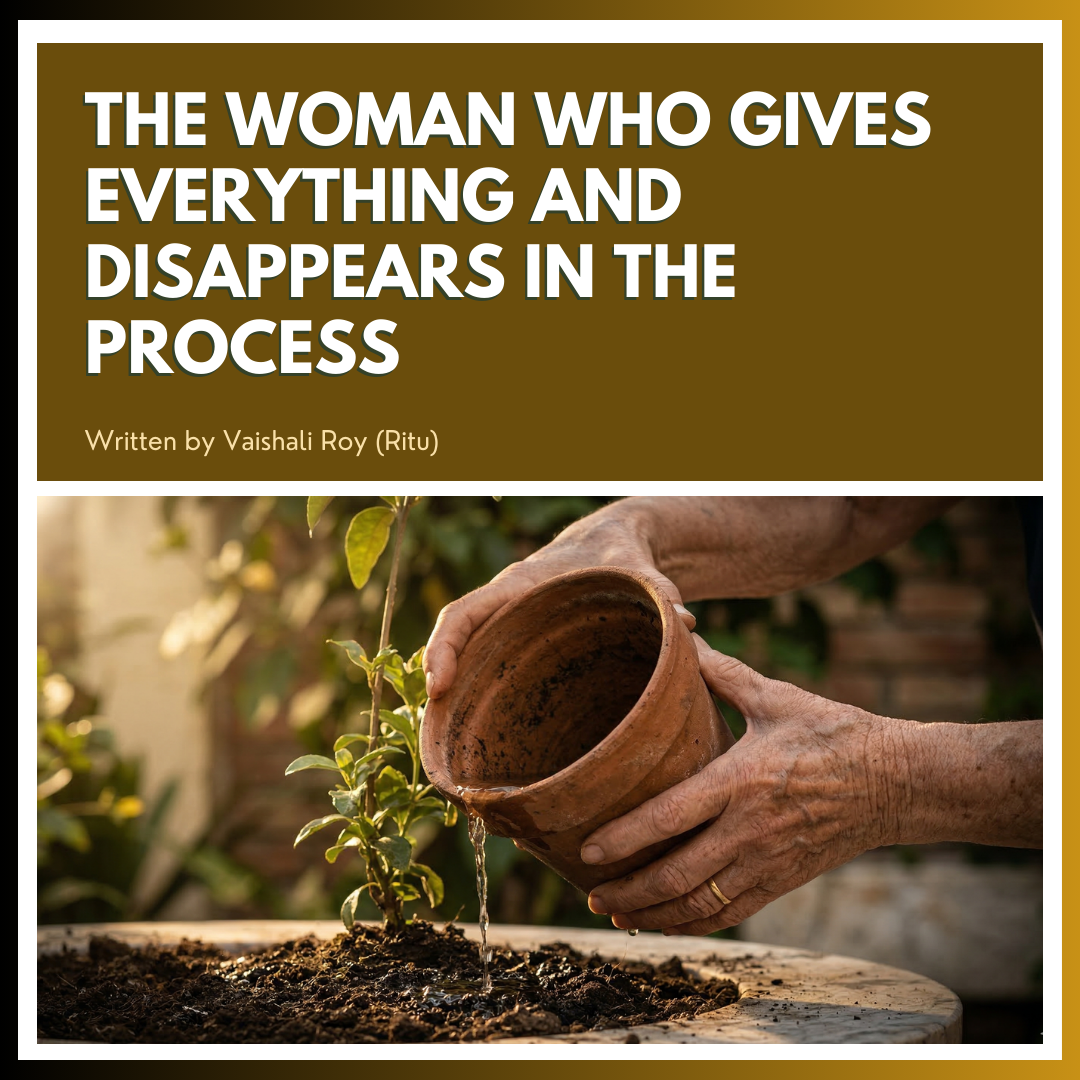
She is the first one up and the last one to rest.
She remembers the doctor's appointments, the grocery list, the anniversary of a friend's difficult day. She adjusts herself before anyone asks. She anticipates every need in every room she walks into.
And when someone calls her strong, she smiles. Because she has been smiling for so long that she no longer remembers what her face feels like when it is completely at rest.
This is not strength. This is what self-abandonment looks like when it has been polished into a virtue.
Where It Begins
No woman decides one morning to stop mattering to herself. It happens gradually, across years, sometimes across a childhood.
A girl who was praised only when she was helpful learned that her value was conditional on her usefulness. A girl whose emotions were called dramatic learned to have them quietly, or not at all. A girl who was never asked what she needed learned that her needs were an inconvenience.
जो बचपन में सिखाया गया, वो बड़े होकर भी चलता रहता है। What is taught in childhood keeps running long after childhood is over.
She carried that girl into every room she ever walked into. Into every relationship she built. Into every version of herself she tried to become.
What It Looks Like in a Woman's Daily Life
Self-abandonment rarely looks like collapse. It looks like function.
It looks like saying yes when every part of you is screaming no. It looks like swallowing your opinion because the room does not feel safe enough for your honest voice. It looks like editing yourself before you speak so the words are easier for others to receive.
It looks like apologising for your needs before you even name them.
It looks like the woman who, when someone finally asks "how are you, really?", does not know what to say. Not because nothing is wrong. Because she has spent so long not checking in with herself that she has genuinely lost the thread back to her own interior.
She is present for everyone. She is absent from herself.
The Cost Nobody Talks About
We celebrate this woman. We call her selfless. We hold her up as an example.
We rarely ask what it is costing her.
The cost is not just exhaustion, though the exhaustion is real and it runs bone-deep. The cost is identity. Over time, a woman who has organised her entire existence around other people's comfort loses the clear sense of who she is when nobody needs anything from her.
She does not know what she enjoys. She does not know what she wants. She does not know what peace feels like in her body because her body has been on alert for so long that rest feels like failure.
खुद को खोना इतना धीरे होता है कि पता ही नहीं चलता। Losing yourself happens so slowly that you do not even notice.
The Moment Things Begin to Shift
The shift does not always come from a dramatic event. Sometimes it comes from a quiet moment when the woman, for the first time in years, sits in a room alone and realises she does not know what she would do if she had nothing to take care of.
That realisation is not a crisis. It is an invitation.
It is the beginning of a question she has never allowed herself to ask: What do I actually need?
Not what is efficient. Not what will keep everyone happy. Not what is the least inconvenient option.
What do I need?
Answering that question honestly, for the first time, is one of the most radical things a woman who has spent years in self-abandonment can do.
What Reclaiming Yourself Actually Involves
It is not a dramatic reinvention. It is a series of small, consistent choices to stop editing yourself out of your own life.
It starts with noticing. Noticing when you say yes and mean no. Noticing when you apologise reflexively. Noticing the moments when you shrink so automatically that it does not even register as a choice anymore.
Then it moves into language. Learning to say "I need" without immediately following it with an apology. Learning to sit with the discomfort of someone else's disappointment without rushing to fix it. Learning that your feelings are not a problem to be managed; they are information to be honoured.
It moves into relationships. Beginning to evaluate which ones are reciprocal and which ones are extractive. Understanding that some relationships were built on the version of you that gave everything. Those relationships may not survive the version of you that also receives.
And that is not a tragedy. That is a recalibration.
जो रिश्ते सिर्फ तुम्हारे देने पर टिके थे, वो रिश्ते नहीं थे। वो arrangements थे। The relationships that only existed because of your giving were never relationships. They were arrangements.
You Were Always Allowed to Matter
The woman who gives everything and disappears in the process is not flawed. She is not broken. She learned, in the only environment she had, that love was something you earned through constant service.
She was wrong. Not because she is foolish. Because she was taught wrong.
Love does not require you to disappear inside it. Strength does not require you to be absent from your own needs. Giving is not a virtue when it is compulsive, when it comes from fear rather than fullness.
You were always allowed to matter. To yourself first. To everyone else second.
That order is not selfish. That order is the only one that is sustainable.
Are you ready to stop disappearing?
If this article lived somewhere inside you, it is because some part of you already knows it is time to come back to yourself.
My one-on-one coaching work is built specifically for women who have spent years giving everything to everyone and are ready, finally, to give something back to themselves.
We work on identity, boundaries, self-worth, and the deeply personal process of reclaiming the woman you were before the world taught you to make yourself small.
If you are ready to begin, I would love to work with you. Visit ritu-roy.com to learn more about coaching with me. 🤍